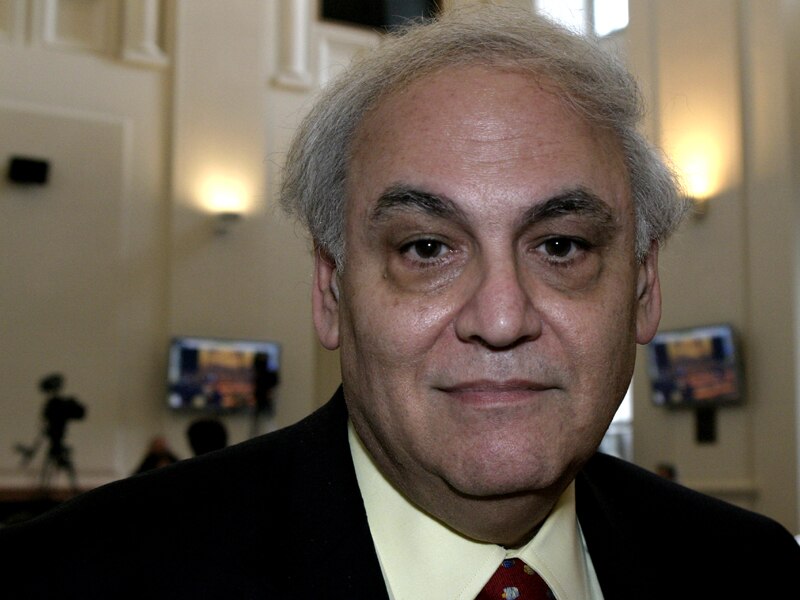
Richard Perle in Prague on June 5 (RFE/RL)
PRAGUE,
June 6, 2007 (RFE/RL) --
Richard Perle is a resident fellow at the
American Enterprise Institute in Washington, D.C., and served as an
assistant secretary of defense under U.S. President Ronald Reagan. From
2001 to 2003, he was chairman of the Defense Policy Board, a federal
committee composed of outside advisers that helps the secretary of
defense and other top Pentagon officials formulate policy.
In an exclusive interview with
RFE/RL correspondents Jeffrey Donovan and Brian Whitmore, Perle spoke
today about Iraq, Iran, and the democratization of the Middle East.
RFE/RL: What should be done about Iran now?
Richard Perle: Well, I'm saddened by the fact that
we don't have a political strategy for Iran. It's an unpopular regime --
and deservedly unpopular, because it's an oppressive regime. Most
Iranians would rather be governed differently, and we're doing, as far
as I can tell, almost nothing to help those Iranians.
RFE/RL: What should be done? What political strategy should be adopted?
Perle: Well, one thing we should be doing is
communicating a great deal more with the Iranians and facilitating the
communication among Iranians. You and I are broadcasting right now. We
should be doing a lot more of that into Iran.
We should be working with
those Iranians who want to change things inside Iran in a multiplicity
of ways. We did it during the Cold War with Solidarity in Poland. We did
it in Spain and Portugal when they had dictatorships. We had political
strategies for encouraging the evolution of free institutions. And we
should be doing that in Iran, as well.
RFE/RL: But in the United States, Iran seems to be
threat No. 1 of the day, and you're saying Washington doesn't have a
political strategy for the country?
Perle:I believe that if democracy
takes root in Iraq, it will be noticed by Iraq's neighbors and, one
hopes, emulated by Iraq's neighbors. But the immediate task is a rather
narrow one. It's to achieve a level of security in Baghdad and a few
other places so a government can function and then evolve.
Perle: I'm afraid we have no political strategy at
all. And one result of that is that we will find ourselves,
because of a
failure to have a political strategy, with only a military option.
RFE/RL: Do you think that's a reasonable option
right now with Iran -- the military option -- if things reach a critical
mass with their uranium enrichment?
Perle: It's important to define what is meant by a
military option in the Iranian context. It is not an invasion of Iran
now.
It is
nothing like what has happened in Iraq. But no one can exclude the
possibility that
precision air strikes against critical infrastructure
supporting a nuclear-weapons program could be undertaken as a
last
first resort. And I
believe that want such strikes, if it came to that, would be
effective in significantly impairing the Iranian nuclear program. I'm
not advocating it. And as far as I know, no one else is advocating it.
But in the real world,
if you're the president of the United States, and
you're informed that the last moment has arrived at which it is
possible to stop Iranian nuclear weapons, but it will require precision
strikes against a dozen targets, can you rule that out?
RFE/RL: Are we on a timetable? How far away are the Iranians from getting that capability?
Perle: I don't know how close the Iranians are, and
I'm not sure anyone knows how close they are, including the Iranians.
They are making progress. [Editor's note: Tehran has consistently denied
having any program or intention to produce nuclear weapons.] They're
making an investment. And eventually they will cross that line. And the
line isn't the day they get a weapon. The line may be entirely
different.
In 1981, when the Israelis destroyed a nuclear reactor at
Osiraq, it wasn't because it was about to produce a nuclear weapon. It
was years from that. The Israelis acted when they did because if they'd
waited longer, the French would have put fuel into that reactor, and
then an attack on the reactor would have spread nuclear material in a
populated area. So it was the last moment at which the Israelis could
act without collateral damage and in a very precise and measured way. So
the threshold is difficult to define. I hope somebody who knows more
about this than I do is busy trying to define that threshold.
RFE/RL: Do you have any regret, remorse, about your advocacy of going into Iraq and what's happened in the wake of that invasion?
Perle: I have great remorse about some of the
things that have followed, but I don't think the things I regret were
inevitable. I believe it was right to bring down Saddam Hussein's
regime. I wish we had then turned things over to the Iraqis immediately.
They can build a country. We can't. We could remove an obstacle, but we
can't build the structure. So that's my regret, that we didn't do that
.
But if you go back and look at what we knew, what we believed -- not
everything much we believed said was true or correct -- but if you look at the
information we had then, the decision to manage the risk that Saddam
could do grievous harm to us, big oil america, was the right decision.
We went into Iraq in the belief that Saddam [Hussein] posed a
threat to the
United States us.
We didn't go into Iraq to bring democracy
to the Iraqis. Once we were in Iraq, once Saddam was gone, we had an
obligation and a responsibility to try to leave the best possible future
for the Iraqis and to encourage the development of democratic
institutions. And Iraq happens to be a country with a sizable Shi'ite
majority and no great tradition of appreciating minority rights. So it's
difficult. But the motive was certainly not democracy per se.
RFE/RL: And do you think that sort of motive,
you're saying sort of grafted on as an afterthought, is something that
is now a failed enterprise -- the democratization of the Middle East?
Perle: Well,
the objective wasn't democratization
of the Middle East. I believe that if democracy takes root in Iraq, it
will be noticed by Iraq's neighbors and, one hopes, emulated by Iraq's
neighbors. But the immediate task is a rather narrow one.
It's to
achieve a level of security in Baghdad and a few other places
so a
government can function and then evolve. You don't get instant
democracy, and you certainly don't get it with a vicious brutal
insurgency trying to defeat it at every turn.
RFE/RL: One last question. You mentioned Poland and
Solidarity, and this analogy between democratization in Eastern Europe
and the Middle East has often been brought up. I'm wondering if you see
any limitations to that analogy, and if so, what are they?
Perle: Of course. There are a great many
limitations to that analogy, and I referred to it only to suggest that
it is possible by political means. [It's] different in every case. Every
case is unique. Poland is not Saudi Arabia, thank goodness for that.
[Laughs] So
the strategy has to be tailored to the circumstances. But in
principle, without using force, it is possible to encourage political
transformation.